
One More Orbit
At a freighter pilot requested clearance to dock, took his place in the queue and promptly changed his mind. The controller's pencil had just snapped. While she fished the tip out of the crease in her logbook, the freighter kept on coming, steady as you please.
“What seems to be the trouble?”
“Fell asleep,” the pilot said. After one unpleasant second it occurred to him to add, “My boy fell asleep. He was waiting for the sun to come up under us. Could we go round once more?”
She stifled a laugh. There were two ships behind him. Letting him out of the queue was easy enough. It would be another matter if he came back in a quarter of an hour and wanted his place back.
“On your next approach you let them both go ahead of you. And it's your fuel.”
“It is,” he said so readily that she wished she could see the sleeping boy. She drew a line across his entry. She used to cross out the callsign too, until the day she spent half a shift hunting for a ship sitting snug at airlock three.
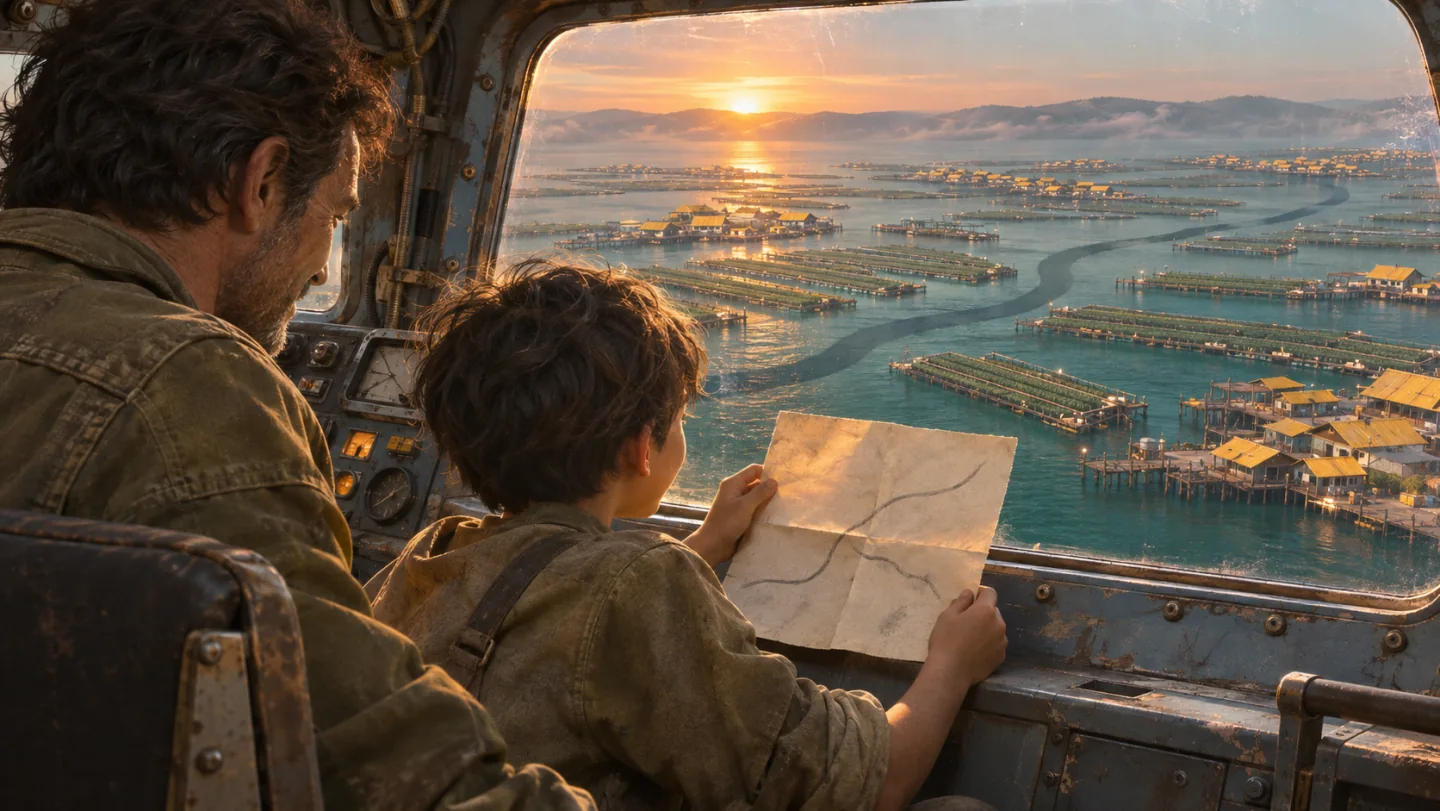
In the cockpit the boy lay asleep with the inside of his cheek caught between his teeth. A drawing folded in four rested on his knees. The night before, his father had suggested bringing a sketchbook. His son had picked out just one sheet, already drawn on both sides. On one side his mother had drawn their floating farm the way she thought it must look from above. On the other the boy had done the same. His father was to judge which of them had got it right. Back home he'd been foolish enough to say he knew these parts with his eyes shut.
“Up you get. Time to find out.”
All through the first half of the flight the boy had asked every five minutes how much longer. His father had promised to tell him when it was time. Now that there was something to see, he found he hadn't the heart to wake him. He turned the cockpit lights down. The boy opened one eye, took a look at the black glass and closed it again.
“Mum's side first,” he mumbled.
For a while nothing changed beyond the glass. Then a streak of light stretched across the water, and rows of farms began to stand out from it like the teeth of a comb. His son was wide awake now. In the middle of the long rectangle in his mother's drawing stood a house. She'd even drawn the four rings on the stove, and on the little one at the back, their dented kettle.
“We've got a yellow roof,” the boy reminded him.
Below them hundreds of roofs shone the very same yellow in the sun. His father nearly pointed to the row nearest the strip of light. That was about where their house ought to be. He could already see the boy drawing a circle round it that evening and his mother hanging the picture above the stove.
“I've never managed to find it from up here,” he said.
“Even when you flew on your own?”
“Especially on my own.”
His son turned the sheet over. All he'd drawn was three crooked sticks and a blot he'd flatly refused to explain at supper. Now he held the paper to the glass and began to turn it. The light had reached the far rows. A little longer and the ship would be past them.
“Could you ask her to slow down?” he said.
“Ask who? The planet?”
The boy snorted with laughter. The paper slipped out of his hands, and quite suddenly he saw three dark, crooked lines in the water. They were the channels between the farms. He and his mother went shopping by boat along one of them. Two turns down another and you were at Grandpa's. Where the blot spread on his drawing, the channel came to a dead end. They'd towed a new farm in last spring, and Grandpa, going the way he'd always gone, had all but put his bow through it.
“Dad, I can see where we live,” he whispered straight into the microphone.
The controller at Niva took her hand off the switch. She'd been listening to the paper rustling all this time, feeling like somebody with an ear to a stranger's door. Now an argument had broken out in the cockpit over who got the pencil. As far as she could tell, the boy won.
When the freighter came back, the woman taking over her shift was already standing behind her. The controller guided it all the way to the airlock herself. Before signing off, she couldn't help asking whose drawing had been right.
“Both,” the boy said. “Mine showed us how to find it. And Mum's shows me where to put the kettle.”
That evening they pinned the sheet above the stove by one top corner. To get from Grandpa's house to the kettle, all you had to do was reach up and turn the paper over.